Risks of lead to wildlife
Lead is also an environmental hazard, and there are no safe lead levels for any biological organism to consume. There are multiple potential sources of lead to wildlife.
Sources of lead for wildlife
- Ammunition Fragments: Lead bullets shatter into tiny pieces on impact. Scavengers like vultures and eagles are poisoned when they eat “gut piles” or carcasses left in the veld.
- Lead Shot: Controlling pests over farmlands can leave millions of lead pellets in the soil. Ploughing (tillage) keeps these pellets reachable for years, and birds often swallow them by mistake [23].
- Fishing Tackle: Crocodiles and waterbirds often swallow lead weights, mistaking them for food or the small stones they use to help digest their food.
- Bio-accumulation: Lead builds up in top predators when they eat smaller animals that are already carrying lead in their bodies.
- Environmental Pollution: Mining and industrial activities can contaminate the soil and water, affecting all local wildlife.
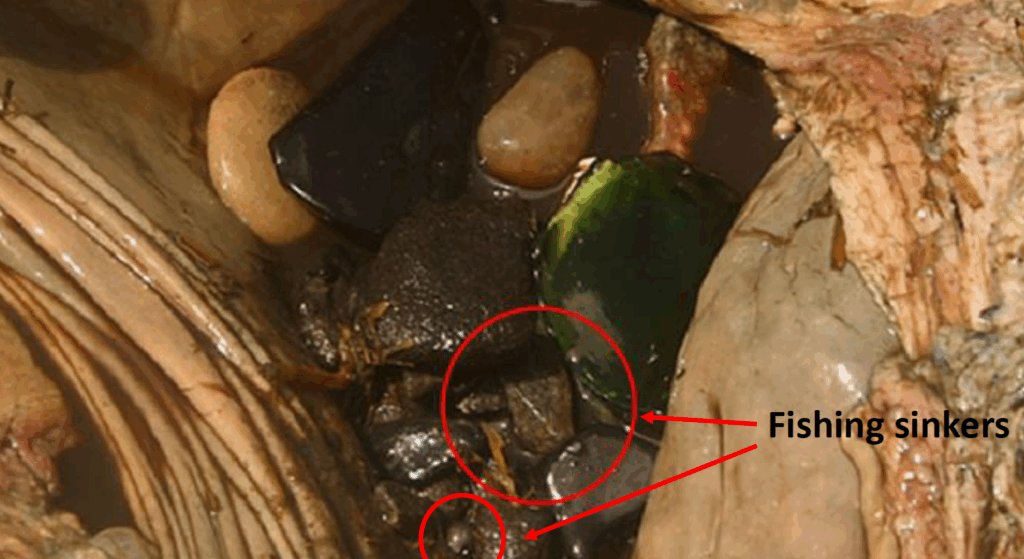
Lead fishing sinkers found in a Nile crocodile [45].
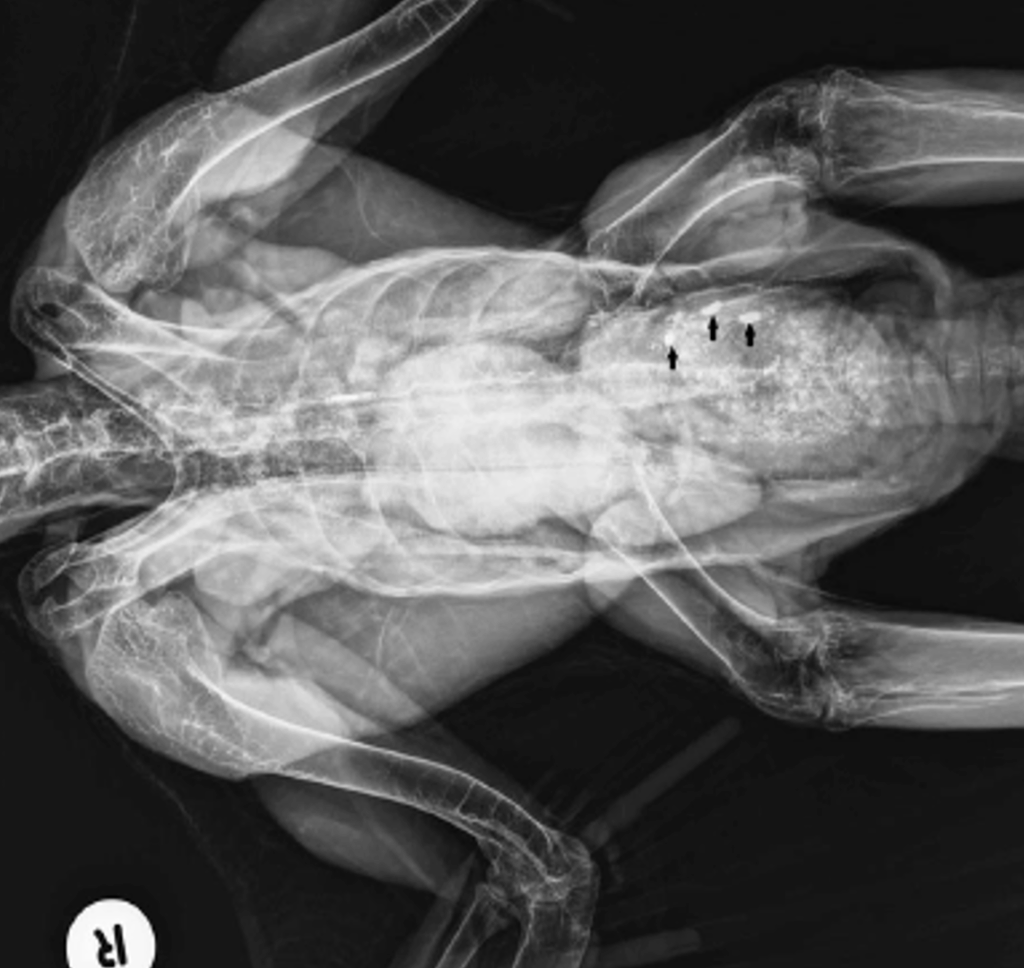
X-ray showing lead fragments ingested by a ground-hornbill.
Species accounts (South Africa)
Across the world, various studies have demonstrated the extent, sources and negative impacts of lead on wildlife. In southern Africa, significantly less work has been undertaken. However, a number of key studies are now assisting in understanding this issue.
Lead affects wildlife on an individual and population level [24].
Sensitivity to lead varies for different groups of animals and even between individuals of the same species. There is still much to learn about the specifics for different species, although some progress has been made for species such as vultures [25] and crocodiles [26].
Birds
- Vultures: A high number of Cape and White-backed Vultures (both adults and chicks) have dangerous levels of lead in their blood [27, 28]. Studies indicate that lead ammunition is the most likely source [29]. Bearded Vultures also show signs of long-term exposure from the food they eat [30].
- Health Impacts on vulture chicks: Vulture chicks with high lead levels cannot produce healthy blood, leading to anaemia. At extreme levels, it causes liver damage [34] and makes it harder for young birds to move or fly properly once they leave the nest.
- Southern Ground-hornbills are extremely sensitive to lead exposure. They can die from lead poisoning at much lower levels than other bird species [31].
- Waterbirds: Recent studies found lethal levels of lead in four South African waterbird species, likely caused by swallowing spent lead shot [32].
- Other Species: Although it has not been investigated in as much detail, birds that are not part of the scavenging and waterbird guilds have so far shown lower lead levels [15]. Before lead was removed from fuel, Laughing Doves in urban areas demonstrated higher lead levels than those in rural areas, linked to inhalation of lead fumes[33].
Reptiles
- Nile Crocodiles: Crocodiles in the St Lucia Estuary have recorded extremely high lead levels [35, 36]. Many were found with lead fishing tackle in their stomachs. High lead causes “classical” poisoning symptoms in crocodiles, such as blackened gums and tooth loss. It also slows their growth rates [37].
- Snakes: Black Mambas living near industrial areas have significantly higher lead levels than those in more natural environments [38].
Mammals
- Information on lead levels in scavenging and predatory mammals is limited.
- Cheetah kept in captivity have died aftet being fed meat contaminated with lead from lead-based bullets or shot [39][40].
- In Namibia, wild leopards (who scavenge dead animals) show high lead exposure from ingesting bullet fragments thought to be related to their opportunistic scavenging of wounded or dead animals containing bullet fragments. In contrast, wild cheetahs from the same areas (which prefer to hunt live prey) show very low lead levels [41].
Fish
Fish in the lower Olifants River carry high levels of lead. This is believed to come from industrial and land-use practices within the river’s catchment area [42, 43].
Invertebrates
Research found that maggots feeding on the skulls of animals shot with lead bullets contained high concentrations of lead [44]. This is a major concern as it shows lead can move through the food chain when these insects are eaten by birds and other small animals.
[23] Thomas, V.G., 1997. The environmental and ethical implications of lead shot contamination of rural lands in North America. Journal of Agricultural and Environmental Ethics, 10(1), pp.41-54.
[24] Rattner, B.A., Franson, J.C., Sheffield, S.R., Goddard, C.I., Leonard, N.J., Stang, D., & Winnie, P.J. (2008). Sources and implications of lead ammunition and fishing tackle on natural resources. The Wildlife Society Technical Review 08-01. The Wildlife Society, Bethesda, Maryland, USA.
[25] Van den Heever, L., Naidoo, V., Coetzer, T., Eyssen, L., Hewlett, J., Smit-Robinson, H.A. and McKechnie, A.E., 2024. Sub-lethal impacts of lead poisoning on blood biochemistry, immune function and delta-aminolevulinic acid dehydratase (δ-ALAD) activity in Cape (Gyps coprotheres) and white-backed (G. africanus) Vulture chicks. Environmental Research, 245, p.117926.
[26] Humphries, M., Myburgh, J., Campbell, R., & Combrink, X. (2022). High lead exposure and clinical signs of toxicosis in wild Nile crocodiles (Crocodylus niloticus) from a World Heritage site: Lake St Lucia estuarine system, South Africa. Chemosphere, 303, 134977.
[27] Naidoo, V., Wolter, K. and Botha, C.J., 2017. Lead ingestion as a potential contributing factor to the decline in vulture populations in southern Africa. Environmental research, 152, pp.150-156.
[28] Van den Heever, L., Smit-Robinson, H., Naidoo, V. and McKechnie, A.E., 2019. Blood and bone lead levels in South Africa’s Gyps vultures: Risk to nest-bound chicks and comparison with other avian taxa. Science of the Total Environment, 669, pp.471-480.
[29] Van den Heever, L., Elburg, M.A., Iaccheri, L., Naidoo, V., Ueckermann, H., Bybee, G., Smit-Robinson, H.A., Whitecross, M.A. and McKechnie, A.E., 2023. Identifying the origin of lead poisoning in white-backed vulture (Gyps africanus) chicks at an important South African breeding colony: a stable lead isotope approach. Environmental Science and Pollution Research, 30(6), pp.15059-15069.
[30] Krüger, S.C. and Amar, A., 2018. Lead exposure in the critically endangered bearded vulture (Gypaetus barbatus) population in southern Africa. Journal of Raptor Research, 52(4), pp.491-499.
[31] Koeppel, K.N. and Kemp, L.V., 2015. Lead toxicosis in a southern ground hornbill Bucorvus leadbeateri in South Africa. Journal of Avian Medicine and Surgery, 29(4), pp.340-344.
[32] Humphries, M., Hunter, G., Pillay, L. and Le Roux, P., 2025. Lead Exposure in South African Waterfowl: Implications for Conservation and Human Health. Archives of Environmental Contamination and Toxicology, pp.1-12.
[33] Siegfried, WR,* Frost, PGH,* Redelinghuys, EP** van der Merwe, R., 1972. Lead concentrations in the bones of city and country doves. South African Journal of Science, 68(9), p.239.
[34] Van den Heever, L., Naidoo, V., Coetzer, T., Eyssen, L., Hewlett, J., Smit-Robinson, H.A. and McKechnie, A.E., 2024. Sub-lethal impacts of lead poisoning on blood biochemistry, immune function and delta-aminolevulinic acid dehydratase (δ-ALAD) activity in Cape (Gyps coprotheres) and white-backed (G. africanus) Vulture chicks. Environmental Research, 245, p.117926.
[35] Warner, J. K., Combrink, X., Myburgh, J. G., & Downs, C. T. (2016). Blood lead concentrations in free-ranging Nile crocodiles (Crocodylus niloticus) from South Africa. Ecotoxicology, 25(5), 950-958.
[36] Humphries, M., Myburgh, J., Campbell, R., & Combrink, X. (2022). High lead exposure and clinical signs of toxicosis in wild Nile crocodiles (Crocodylus niloticus) from a World Heritage site: Lake St Lucia estuarine system, South Africa. Chemosphere, 303, 134977.
[37] Davhana, F., Humphries, M., Hunter, G., Seoraj-Pillai, N., & Combrink, X. (2025). Exposure of sub-adult Nile crocodiles (Crocodylus niloticus) to extreme lead concentrations: a 48-week experimental study with implications for wild populations. Archives of Environmental Contamination and Toxicology, 1-14.
[38] Humphries, M., Evans, N., Price, C. and Alexander, G.J., 2025. Black mambas (Dendroaspis polylepis) as novel bioindicators of urban heavy metal pollution. Environmental Pollution, p.126730.
[39] North, M.A., Lane, E.P., Marnewick, K., Caldwell, P., Carlisle, G. and Hoffman, L.C., 2015. Suspected lead poisoning in two captive cheetahs (Acinonyx jubatus jubatus) in South Africa, in 2008 and 2013: Case report. Journal of the South African Veterinary Association, 86(1), pp.1-5.
[40] Hauw, C., Schmidt-Küntzel, A., Basto, A.F., Yabe, J., McCann, N., Díez-León, M. and Marker, L., 2025. Case Report: Acute lead poisoning from bullet ingestion in a captive cheetah (Acinonyx jubatus) in Namibia: implications for wildlife management. Frontiers in Veterinary Science, 12, p.1576760.
[41] Hauw, C., Marker, L., Yabe, J., Díez-León, M., McCann, N., Iiputa, G., Jago, M., Mukete-Hilundutah, E., Nzehengwa, T., Banda, N. and Nakayama, S.M., 2025. Lead Bullet Burden: Widespread Lead Exposure in Wild Carnivores and Unseen Consequences of Feeding Lead-Shot Meat to Captive Cheetahs (Acinonyx jubatus). The Journal of Wildlife Diseases, 61(4), pp.1038-1049.
[42] Coetzee, L., Du Preez, H.H. and Van Vuren, J.H.J., 2002. Metal concentrations in Clarias gariepinus and Labeo umbratus from the Olifants and Klein Olifants River, Mpumalanga, South Africa: Zinc, copper, manganese, lead, chromium, nickel, aluminium and iron. Water SA, 28(4), pp.433-448.
[43] Lebepe, J., 2018. Assessment of the effects of environmental contaminants on feral fish populations in the Olifants River system (Doctoral dissertation, University of Limpopo).
[44] Kempen, M. 2023.Metaal overdracht van geschoten wildkarkassen naar bromvlieg en (Calliphoridae) in KwaZulu – Natal (Zuid-Afrika). Master in de Milieuwetenschap.
[45] Blood lead concentrations in free-ranging Nile crocodiles (Crocodylus niloticus) from South Africa – Jonathan Warner, Xander Combrink, Jan Myburgh and Colleen Downs (2016)
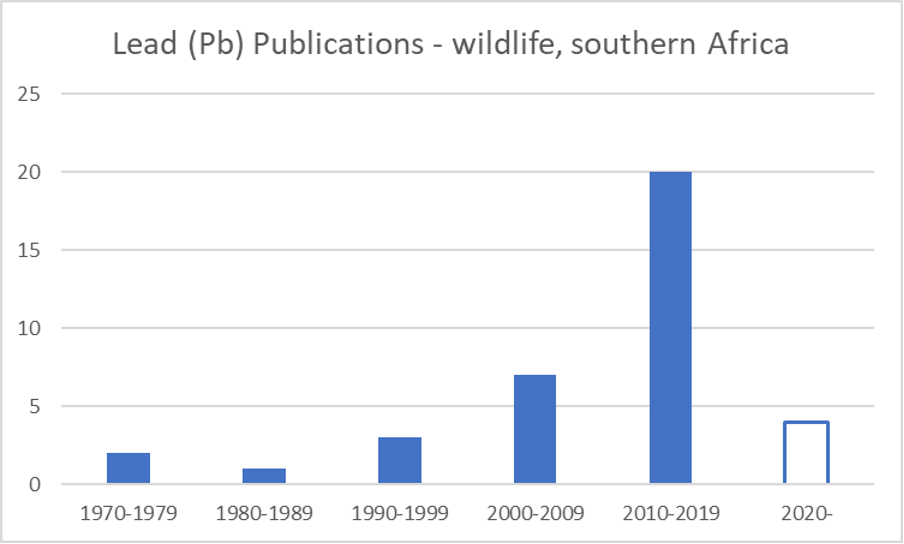
The more we look, the more we find…
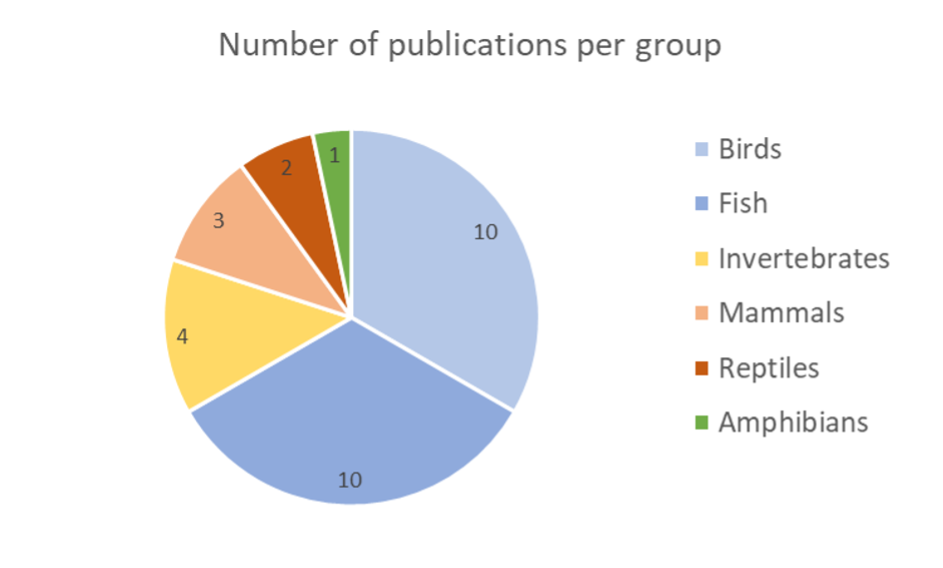
There are now 37 publications on lead in wildlife in Southern Africa.